Researchers found that healthcare professional high in emotional intelligence are far more effective in a number of key performance areas including stress management, showing that these skills are critical for healthcare professionals – and especially those in leadership positions.

While stress is a challenge to almost everyone, the way doctors and nurses cope with stress can be a matter of life and death. Fortunately new research reveals one key for dealing with the pressure: emotional intelligence.
In a study conducted with the obstetrics department of a major urban hospital in Bologna, Italy, the healthcare professionals high in emotional intelligence scored far better in an assessment of job performance and life success. The highest performers scored an average of over 30% better on the “Six Seconds Emotional Intelligence Assessment,” a powerful measure of essential competencies for being smart with feelings.
Study coauthor Lorenzo Fariselli, manager of research for Six Seconds Italy, explained the importance of the finding: “Stress is increasingly challenging for organizations and professionals worldwide, but it’s been unclear how to most effectively manage this problem. Now we know that emotional intelligence is one of the most important ingredients for professionals to effectively cope and thrive in a challenging work environment.” A White Paper explaining the study is online and more research is available on www.6seconds.org/tools/sei/research (a powerpoint of the key points is also available on either page).
The correlation between EQ and scores on the performance assessment are shown visually in this graph where each dot is one person’s scores on both assessments. The graph shows that in general as EQ increases (on the vertical axis) so does Performance (on the horizontal). The strength of this relationship is expressed in “R-squared;” .6621 is quite high.
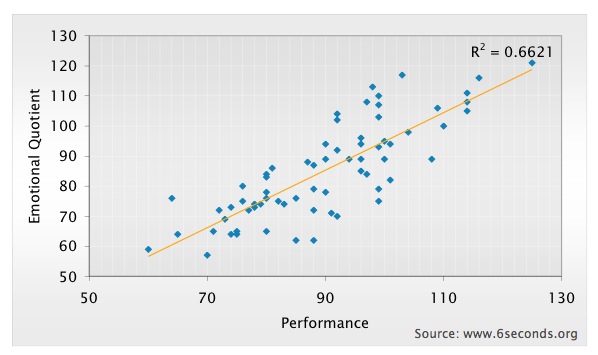
The study also found that the power of EQ, or emotional intelligence, was even greater for the most senior team members. While on average EQ explains over 66% of the variation in performance scores, for the most senior team members that increases to nearly 80%. In other words, the more senior you are, the more important it is to be an expert with emotions.
Joshua Freedman is Chief Operating Officer of Six Seconds and one of the world’s leading authorities on the development of emotional intelligence. “Around the globe we’ve seen that emotional intelligence is the difference that makes the difference. Leaders who choose to be emotionally intelligent create mission success and drive value,” Freedman says.
Freedman says many organizations view EQ as an investment they might make when they have the resources, but he offers a different suggestion: “EQ is most essential in times of stress and challenge; training in this area is a ‘life ring,’ not an ‘investment.’” He is quick to point out that developing these skills isn’t a major expense in time and resource — “We’re not talking about implementing some expensive or complex new system. EQ is something to be – a little more each week.”
Emotional intelligence (abbreviated “EQ” for “emotional quotient”) continues to gain attention around the world as an essential asset for success in work and life. The science grows from research by Peter Salovey (Yale University) and John Mayer (University of New Hampshire) who published their first papers in 1990 showing how we have intelligence with emotions. EQ was popularized in the mid 1990s by New York Times science writer Daniel Goleman. To help people understand how to develop and apply this breakthrough concept, Six Seconds was established in 1997.
Six Seconds, The Emotional Intelligence Network, is the world-leading resource for emotional intelligence development with offices in six countries and over 1500 certified practitioners world-wide. A not-for-profit organization, Six Seconds advocates for the importance of EQ and supports change agents making a positive difference in every sector of society (see www.6seconds.org for more).

- Leading Kindness: When College Students Practice EQ in Service of Others, Their Own Emotional Intelligence Increases - April 9, 2026
- Emotional Intelligence in Healthcare: A Quick Check-In Guide to Improve Patient Care and Reduce Burnout - November 18, 2025
- Plutchik’s Wheel of Emotions: Feelings Wheel - February 6, 2025